

Cleaning limestone paving safely starts with one rule: avoid acidic cleaners. For routine maintenance, sweep away loose debris, rinse with clean water and use a pH-neutral or limestone-compatible cleaner only when necessary. Algae, black spot, oil, rust and cement residue require different treatments, so identify the contamination before applying chemicals or increasing pressure.
Quick Answer: The safest way to clean limestone paving is to start with sweeping, clean water and gentle brushing. For heavier contamination, use a cleaner specifically approved for exterior limestone. Never use vinegar, brick acid or generic acidic patio cleaners because limestone contains calcium carbonate and can be permanently etched by acids.
Quick Answers About Cleaning Limestone Paving
What is the best way to clean limestone paving?
Start with the least aggressive method. Sweep away leaves and grit, wet the paving, wash with clean water and agitate with a soft or medium-stiff non-metallic brush. If dirt remains, use a pH-neutral or limestone-compatible cleaner according to the manufacturer's instructions.
Can vinegar be used to clean limestone paving?
No. Vinegar is acidic and reacts with the calcium carbonate in limestone. It can chemically etch the surface and leave permanent pale, dull or rough areas rather than simply cleaning it.
Can bleach be used on limestone paving?
Household bleach and improvised bleach mixtures are not recommended as routine limestone cleaners. Some specialist non-acidic products containing sodium hypochlorite may be suitable for algae or biological growth, but only where the manufacturer specifically confirms compatibility with the exact limestone and finish.
Can you pressure wash limestone paving?
Yes, but cautiously. Sound limestone and stable joints can sometimes be pressure washed using the lowest effective pressure, a wide fan spray and a sensible working distance. Avoid turbo nozzles, concentrated jets and close-range blasting because these can damage joints, edges and vulnerable stone surfaces.
How do you remove black spots from limestone paving?
Persistent black spots are commonly associated with established lichen or other biological growth. Use a specialist non-acidic black spot treatment whose manufacturer specifically approves it for limestone. Pressure washing alone may remove surface contamination without fully treating established growth.
How to Clean Limestone Paving Safely
- Sweep the paving to remove leaves, soil, grit and loose debris.
- Wet the surface with clean water.
- Wash with water first and gently agitate using a suitable non-metallic brush.
- Apply a limestone-compatible cleaner only if water and brushing are insufficient.
- Follow the stated dilution and dwell time rather than increasing the chemical strength.
- Rinse thoroughly with clean water.
- Allow the limestone to dry before assessing the final result.
- Repeat or use a specialist treatment only after identifying the remaining stain or contamination.
Regular Cleaning for Limestone Patios
Routine limestone maintenance is generally straightforward when contamination is removed before it becomes heavily established.
Sweep the patio regularly to remove soil, leaves, food debris and abrasive grit. Wet organic debris should not be left on the paving for long periods because persistent moisture can encourage algae and moss, while leaves and plant material can transfer tannins and other natural staining.
For ordinary surface dirt, clean water and a soft or medium-stiff non-metallic brush may be sufficient. Work across the slab evenly rather than aggressively scrubbing one small area, then rinse away loosened contamination.
Pay particular attention to joints, drainage channels and low areas. Repeated biological growth is often partly an environmental problem rather than simply a cleaning problem.
Maintenance Tip: If algae repeatedly returns to the same area, check for persistent shade, standing water, blocked drainage, leaking gutters, nearby vegetation or poor airflow instead of repeatedly increasing chemical strength.
What Cleaner Should You Use on Limestone Paving?
A cleaner should be selected according to both the stone and the type of contamination.
For routine dirt, a pH-neutral cleaner specifically approved for limestone or calcium-carbonate natural stone is a sensible starting point.
Different specialist products may be needed for:
- algae and moss;
- lichen and black spot;
- oil and grease;
- organic staining;
- rust marks;
- cement or jointing contamination; and
- previous sealer or treatment problems.
Follow the manufacturer's stated dilution, coverage, temperature, dwell time and rinsing instructions. Do not assume that using a stronger concentration or leaving a product on for longer will improve the result.
Always test a new cleaner on a spare slab or inconspicuous area and assess the result after the limestone has completely dried.
Never Mix Cleaning Chemicals: Mixing bleach or sodium-hypochlorite products with acids, ammonia or other cleaning chemicals can create dangerous chemical reactions and fumes.
Why Should Acidic Cleaners Be Avoided on Limestone?
Limestone is acid-sensitive because it contains calcium carbonate. Acids chemically react with the stone itself.
Products and household substances that should not be used as general limestone cleaners include:
- brick acid;
- hydrochloric-acid cleaners;
- acidic cement removers;
- vinegar;
- lemon juice; and
- patio cleaners that are not specifically confirmed as limestone-safe.
Acid attack can remove material from the surface and produce pale, dull, rough or etched areas.
This is fundamentally different from ordinary staining. Once the stone surface has been chemically etched, the missing material cannot simply be washed back into place.
Important: Never try to remove cement contamination from limestone with brick acid. Also do not attempt to disguise one acid-damaged patch by treating the whole patio with acid. This increases the damaged area rather than restoring the original surface.
How to Remove Algae and Moss from Limestone Paving
Green algae and moss commonly develop where patios remain damp, shaded or covered with organic debris.
Begin by sweeping or brushing away loose material. Wash the area with clean water and gently agitate the surface.
Where this is insufficient, use a non-acidic outdoor stone cleaner specifically approved for limestone.
Some proprietary products designed for biological growth contain sodium hypochlorite. These should only be used where the manufacturer confirms suitability for the exact limestone and finish.
Where such a product is used:
- follow the stated dilution;
- observe the stated dwell time;
- wear the required personal protective equipment;
- protect plants, metals and adjacent materials;
- do not allow the cleaner to dry unless specifically instructed; and
- rinse thoroughly afterwards.
Household bleach and improvised bleach mixtures should not be treated as general-purpose limestone cleaners. Their concentration and application may be poorly controlled, and misuse can affect stone colour, existing treatments, planting and surrounding materials.
How to Remove Black Spot from Limestone Paving
Persistent black spots on outdoor paving are commonly associated with established lichen or similar biological colonisation. These marks can become anchored into surface irregularities and are considerably more difficult to remove than loose dirt or superficial algae.
Pressure washing alone should not be relied upon as the treatment. Increasing pressure may damage the paving or joints without eliminating established biological growth.
Instead:
- remove loose dirt and debris;
- identify a specialist non-acidic black spot or lichen treatment approved for limestone;
- test it on a discreet area;
- apply it according to the manufacturer's instructions;
- allow the specified dwell time;
- agitate only where instructed;
- rinse thoroughly; and
- allow the paving to dry before deciding whether further treatment is required.
Established black spot may require more than one controlled treatment. Do not compensate by exceeding the manufacturer's concentration or dwell-time instructions.
Long-term control also requires attention to the conditions that allowed biological growth to establish, particularly persistent dampness, shade, debris and poor drainage.
How to Remove Stains from Limestone Paving
There is no single limestone cleaner that is appropriate for every type of stain. Correct diagnosis should come before chemical treatment.
| Stain or Mark | Recommended First Step | What to Avoid |
|---|---|---|
| Leaves and tannins | Remove the source, rinse with clean water and use a limestone-compatible organic-stain cleaner if required | Leaving wet leaves in place or using acidic cleaners |
| Algae and moss | Brush loose growth and use a limestone-safe biological cleaner where necessary | Repeated aggressive pressure washing |
| Black spot or lichen | Use a specialist non-acidic treatment approved for limestone | Acid-based black spot removers or excessive pressure |
| Food, grease or barbecue oil | Blot promptly and use a limestone-compatible degreaser or suitable poultice | Spreading the contamination by aggressive scrubbing |
| Rust marks | Remove the metal source and identify a non-acidic treatment specifically approved for limestone | Generic rust removers without checking composition |
| Cement or mortar residue | Identify the residue and obtain advice on a limestone-compatible removal method | Brick acid and generic acidic cement removers |
| White haze or deposits | Allow the paving to dry and determine whether the cause is salts, jointing residue or moisture movement | Immediately sealing over the problem |
| Paint or unknown chemicals | Identify the contaminant before selecting a compatible specialist treatment | Random solvents or mixed chemicals |
Where the stain cannot be confidently identified, test the least aggressive appropriate method first or obtain specialist natural-stone advice.
Can You Pressure Wash Limestone Paving?
Sound limestone paving can be pressure washed cautiously, but more pressure does not mean better cleaning.
The risk depends on the stone, surface finish, age of the patio, joint condition and equipment being used.
When pressure washing limestone:
- use the lowest effective pressure;
- use a wide fan nozzle rather than a concentrated jet;
- maintain a sensible working distance;
- keep the nozzle moving;
- work evenly across the paving;
- avoid directing water into joints; and
- test an inconspicuous area first.
Avoid: Turbo nozzles, zero-degree jets, close-range blasting and repeatedly concentrating the jet on one mark. These methods can disturb jointing, damage vulnerable edges, expose weaker stone surfaces and leave visible cleaning lines.
Older patios, deteriorated limestone and paving with loose or damaged joints may be better cleaned manually or assessed professionally before pressure washing.
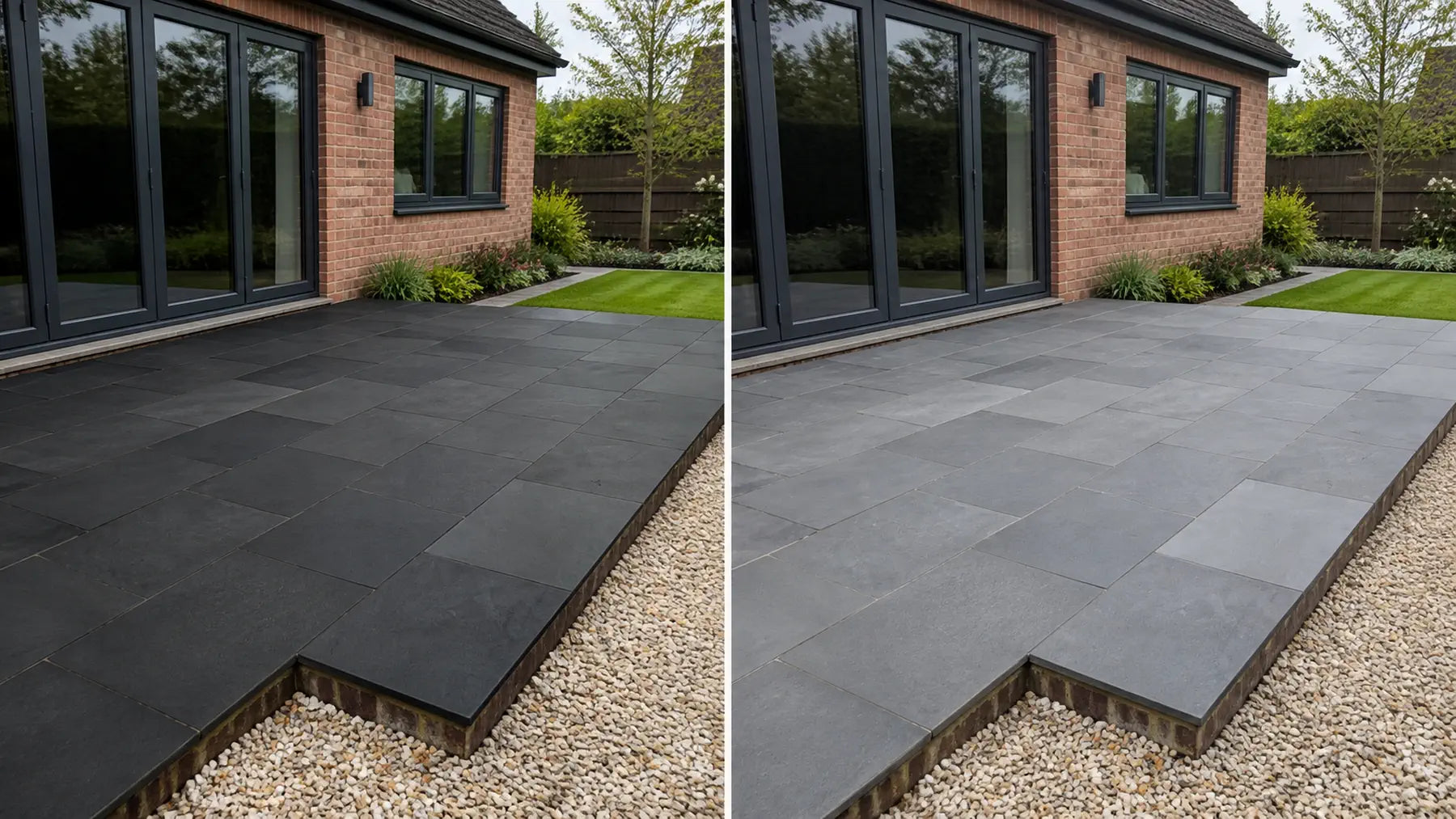
How to Clean Black Limestone Paving
Black limestone paving needs particular care because pale deposits, chemical damage and uneven cleaning can be much more visible against a dark surface.
Before cleaning, determine whether the light or patchy appearance is caused by:
- ordinary dirt;
- algae or biological growth;
- mineral or salt deposits;
- cement or jointing contamination;
- normal surface weathering;
- acid etching; or
- a previous sealer or treatment.
These causes require different responses.
Do not assume that increasingly aggressive cleaning will restore the original deep-black colour. Natural weathering of black limestone is not the same as surface dirt.
A compatible colour-enhancing impregnator may deepen the appearance of suitable weathered limestone after correct preparation, but it cannot replace material removed through acid attack or guarantee that the stone will remain permanently black.
Read Why Black Limestone Turns Grey before treating faded or uneven black paving.
How to Remove Cement and Mortar Stains from Limestone
Do not use brick acid or a generic acidic cement remover on limestone.
Cement-related marks can include several different problems:
- fresh mortar contamination;
- hardened cement deposits;
- slurry primer dried onto the surface;
- jointing compound residue;
- cement haze; or
- salts or deposits associated with moisture movement.
These should not automatically be treated in the same way.
Fresh contamination should be controlled during installation before it hardens. Once residue has cured, identify the exact material before attempting removal.
If a mark repeatedly returns after cleaning or follows joint lines, investigate moisture movement, installation materials and drainage rather than simply applying increasingly aggressive cleaners.
Should Limestone Be Sealed After Cleaning?
Sealing limestone paving after cleaning is optional rather than compulsory.
A suitable impregnating sealer can reduce the rate at which some limestone absorbs water, oils and contaminants and may therefore make future maintenance easier.
Sealing can be particularly worth considering:
- around outdoor dining areas;
- near barbecues or outdoor kitchens;
- beneath trees;
- on frequently used patios;
- where oil or food staining is more likely; or
- where a compatible colour-enhancing treatment is specifically wanted.
However, paving should not be sealed simply because it has just been cleaned.
The limestone must first be sufficiently clean and dry, and unresolved staining, damp patches, salts, drainage problems and biological contamination should be dealt with before treatment.
A sealer cannot make limestone completely waterproof, stain-proof, acid-resistant or maintenance-free.
Read Does Limestone Paving Need Sealing? before selecting a treatment.
How to Keep Limestone Paving Clean for Longer
- Sweep leaves, soil and grit away regularly.
- Remove food, drinks and oil spills promptly.
- Do not leave wet leaf piles or plant debris on the paving.
- Keep joints and drainage channels clear.
- Improve drainage where standing water regularly develops.
- Move planters periodically to allow the surface beneath to dry.
- Use suitable feet beneath metal furniture to reduce rust staining.
- Use only cleaners specifically compatible with limestone.
- Never use vinegar, brick acid or unverified acidic household remedies.
- Pressure wash only when necessary and with controlled settings.
- Keep a record of cleaners and sealers previously applied to the paving.
Frequently Asked Questions
What is the safest way to clean limestone paving?
The safest approach is to sweep away loose debris, rinse with clean water and gently brush the surface. If this is insufficient, use a pH-neutral or limestone-compatible cleaner according to the manufacturer's instructions. Always test unfamiliar products first.
Can vinegar or brick acid be used on limestone paving?
No. Vinegar, brick acid and other acidic cleaners react with the calcium carbonate in limestone and can permanently etch, lighten or roughen the surface. Use a cleaner specifically approved for limestone instead.
Can bleach be used on limestone paving?
Household bleach and improvised bleach mixtures are not recommended for routine limestone cleaning. Some specialist sodium-hypochlorite-based cleaners may be suitable for biological growth where the manufacturer specifically confirms compatibility with the exact limestone and provides clear dilution, dwell-time and rinsing instructions.
Can limestone paving be pressure washed?
Yes, sound limestone paving can be pressure washed cautiously. Use the lowest effective pressure, a wide fan nozzle and a sensible working distance, and keep the jet moving. Avoid turbo nozzles, concentrated jets and close-range blasting, particularly around joints and slab edges.
How do you remove black spots from limestone paving?
Use a specialist non-acidic black spot or lichen treatment specifically approved for limestone. Follow the manufacturer's concentration and dwell-time instructions and expect established growth to require more than one controlled treatment. Pressure washing alone may not fully remove deeply established biological growth.


